Why Economic Growth
Everything good in life depends on it.

“Markets are not just about the steam engine, iron foundries, or today’s silicon-chip factories. Markets also supported Shakespeare, Haydn, and the modern book superstore. The rise of
oil painting, classical music, and print culture were all part of the same broad social and
economic developments, namely the rise of capitalism, modern technology, rule of law,
and consumer society.”
— Tyler Cowen, Discover Your Inner Economist [1]
When I was an undergraduate studying cognitive neuroscience, I became convinced that end-of-life brain disease would be one of the great problems of the century. The baby boomers were entering their 80s, and anyone who lives long enough will eventually face some combination of Alzheimer’s, Parkinson’s, or dementia. The suffering is enormous—not only for patients, but often more painfully, for their families.

Originally, I thought I would research all three. In fact, I felt a moral obligation to do so. Then, I hit the usual academic wall: what do you want to specialize in? I had assumed I would be a leading expert on most end-of-life brain diseases by the end of my education, but quickly learnt that was impossible. The field is hyper-specialized by necessity. Gone are the days of aristocratic polymaths who have mastered all 12 of the sciences.
That sucked. One likes to imagine there is enough time in a life to solve at least a few big problems.
Eventually I realized the constraint wasn't intellectual. I was capable of learning any one of the given fields. It was material: time, money, and attention are scarce. No single person can push three major research programs forward at once no matter how bright.
If I wanted progress across multiple frontiers simultaneously, I didn't need to approach omniscience. I needed thousands of people becoming world experts in one thing each. The bottleneck wasn't my competence; it was the size and specialization of the scientific community.
If I wanted more researchers, however, I couldn’t simply wish them into existence. Researchers require laboratories, salaries, graduate stipends, MRI machines, reagents, computing power, office buildings, journals, electricity, and countless other scarce resources. Every additional scientist working on Alzheimer’s is someone who must be fed, housed, educated, and equipped by the productive efforts of millions of other people. Scientific progress is never limited only by ideas; it is limited by the material abundance that makes those ideas possible.
But once I accepted that logic, another thought occurred to me: what about all the research problems I know nothing about? And what about the research projects that I don’t even know that I know nothing about?
Who am I to say the problems I’m working on are more important than theirs? Cancer researchers are certainly more important than me. I’m sure even the people doing squirrel and bat linguistics (a blossoming field in Canada and Scotland)[3] feel they are working on big problems with huge implications.
I came to realize that I don't need to know whether Alzheimer's research needs another MRI scanner or another graduate student. The researchers themselves already know best. If all of society becomes wealthier, every discipline gains the freedom to pursue the opportunities its own experts judge most valuable.
And in that sense, the most direct way for me to contribute to Alzheimer’s research, Parkinson’s research, and every other problem I care about—known and unknown—is to grow the economy.
“The consequences for human welfare involved in questions like these are simply staggering: Once one starts to think about them, it is hard to think about anything else.”
— Robert E. Lucas, On the Mechanics of Economic Development [4]
The more one thinks of economic growth, the more all-encompassing it starts to become. It ceases looking like a “sector” of society and starts to look like the boundary that contains and defines what society is: a measure of what civilization can attempt simultaneously.
Economic growth does not stop at the boundaries of science. It bleeds into every corner of life. As people become wealthier, they become freer to pursue whatever they think is worth pursuing.
Some spend that freedom trying to cure Alzheimer’s. Others build better woodworking tools, compose music, write fantasy novels, perfect espresso machines, invent better kitty litter, or make absurdly realistic flight simulators. Some devote themselves to painting. Others to pornography. Civilization has room for all of them, so long as it continues to grow.
Even romance is downstream of growth. Sociologist Ludwig von Mises argued that the love-marriage — choosing a partner by affection rather than by parental strategy or economic necessity — is a strikingly recent arrangement, one that the contractual, individualist society built atop material surplus made possible. For most of history, marriage was a treaty between households and women were closer to property than parties to it.[5] Only once growth loosened the grip of the family economy did whom you wanted start to outweigh whom you needed. So the next time you take a cutie on a date, thank the compound interest of two centuries of accumulated capital. A true boon to lovers everywhere.
That is one of growth’s least appreciated but most profound virtues. It does not merely produce more goods. It shifts the authority to decide which goods and economic relations should exist away from kings, priests, aristocrats, bureaucrats, and tight family structures; and toward the individual.
Economic growth has been the great leveler of caste and privilege, turning every proletarian into a bourgeois, and making the factories and superstores of today serve the masses rather than an aristocratic few. The average consumer vies daily over control of production by casting ballots in an unending election: a single penny entitles any individual in society a right to a vote for how the entire economy will be structured.
Capitalism is essentially a system of mass production for the satisfaction of the needs of the masses. It pours a horn of plenty upon the common man. It has raised the average standard of living to a height never dreamed of in earlier ages. It has made accessible to millions of people enjoyments which a few generations ago were only within the reach of a small elite.
— Ludwig von Mises, The Anti-Capitalistic Mentality [6]
When people hear “economic growth” they first picture yachts, oil refineries, or a wall of FunkoPops, then reasonably decide the whole project is a bit vulgar and hedonistic. But that picture is a sleight of hand. Growth is the yachts, true, but it’s also the printing press, the microwave, childhood vaccines, the public library, LiDAR, antibiotics, bread that doesn’t have sawdust in it, and the Hubble telescope that lets us examine the edges of the universe. The same growth that gives one man a jet ski gives another a cochlear implant and a third the entire published corpus of Alzheimer’s research, for free, on a laptop in her private and air-conditioned apartment. You don’t get to keep the parts of modernity you find tasteful and discard the rest. They come from the same place. The microwave and the MRI machine are cousins.
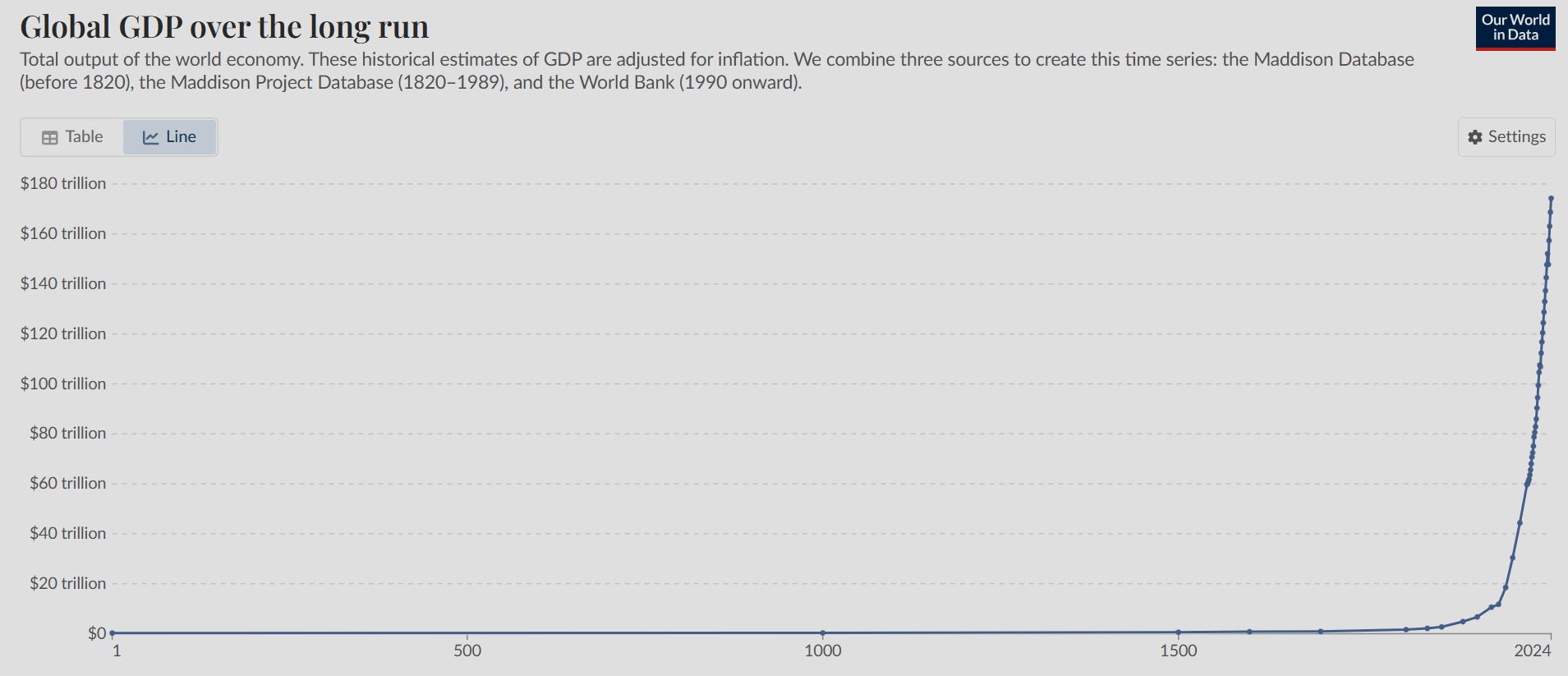
It took the genus Homo (the most intelligent fella around) nearly 2 million years to figure out farming and civilization,[7] let alone capitalism, and then sustained technological innovation. Sustained growth is a wild historical anomaly, not a default, and nearly all human lives were lived without it. Growth is extremely precious and should not be presumed.[8]
Against the Romanticization of Poverty
I love Studio Ghibli films. A quaint cottage in the countryside, and a long, unhurried meal of rice and vegetables, picked from your own garden in the front yard. There is something in us that aches for simplicity and purity, and I don't think that ache is going away any time soon. But it is an idealized portrait created by nostalgia-wielding animators that are themselves trying to sell you a feeling: not a historic portrayal of a now vanquished golden age.
Out of the frame: your animals catch a disease nobody understands then die in a week, and because they were your food, you starve through the winter. One bad harvest and there is no ship from Argentina, no truck from California, and no global market to smooth the shortfall. There are only withered crops, you, and your children, starving to death, slowly and horrifically.
The baker pads his loaf with chalk and ground stone[9] to stretch the flour and skew the scales, and when you complain he shrugs and blames the mill, because there’s no accountability, and no other baker across the street to defect to. The pastoral fantasy is a fantasy precisely because someone, somewhere (probably in a city), has already fixed all the things that used to kill you.
And—best of all—the bad harvest hit the neighboring villages too, so now they’re coming over the hill to take your food stores by force, because raiding is what you do when trade isn’t an option and the alternative is starvation.
People sneer at the preservatives and additives in modern food as though they were a poison. They are largely the opposite. They are what victory over famine actually looks like up close: unglamorous, industrial, a little ugly, and the reason almost none of us will ever watch a child starve to death after a bad harvest in front of our eyes. The romantics have it backwards. The garden was never Eden, it was the gruesome status quo in a world defined by frequent and mass starvation.
Other objections to growth (the usual suspects)
Critiques of growth tend to cycle through familiar forms.
In one decade, capitalism is stagnant. In another, it is too opulent. In another, it is too unequal. Then too polluting. Then too consumerist. Stagnation; deficient growth; overaffluence; overpoverty; hyperabundance; ad infinitum.
As some historians have noted with irony, the intellectual fashions change faster than the problems themselves.
But beneath the noise, three objections remain worth taking seriously:
Distributional woes. Does growth mean everyone gets wealthier, or just a small few?
Environmental decay. Does growth today mean a destroyed planet for future humans and other sentient beings?
Moral legitimacy. Does economic growth come from exploitation? If it does, we cannot justify enriching the masses when it comes knowingly from the suffering of others.
Everything else is usually a variant of one of these.

The environmental problem
The environmental objection is the trickiest to navigate with nuance and care. History is full of well-intentioned attempts to improve living standards that produced devastating downstream consequences.
I am thinking first and foremost of Chairman Mao’s order to desecrate sparrows in order to preserve crops. This in turn led to an explosion in locust populations a few years later, which destroyed more crops than the sparrows ever had.[10]
That is, perhaps, a very obvious example, which we could reasonably expect not to repeat. But it is very hard to draw clear borders around which policies will be contained in a set of cause and effects, and which will escape the cognition of the planner and have enormous unforetold spillover effects far into the future.
Who’s to say a 2°C increase in global temperatures won’t produce heat-resistant fungus which can invade the human body? Our immune system’s first line of defence against fungus is simply the heat from our bodies. Most environmental fungi simply can't grow at 37°C[11] — should temperatures slowly rise and fungus adapt, we may all become mushroom food.[12]
In a system as complex as all life on Earth, containing numerous equilibria of entire ecosystems, can we reasonably expect to impose our will without bad consequences? It can seem especially unlikely given that the organisms we act upon are themselves evolving in response to our interventions.
The environmental objection is also the most emotionally forceful: growth destroys. More growth means more destruction. More production means more extraction, more emissions, more habitat loss. If we keep growing, we cook the planet.
This would be serious if growth meant what its critics assume it means — more of everything, indefinitely, at the same input intensity.
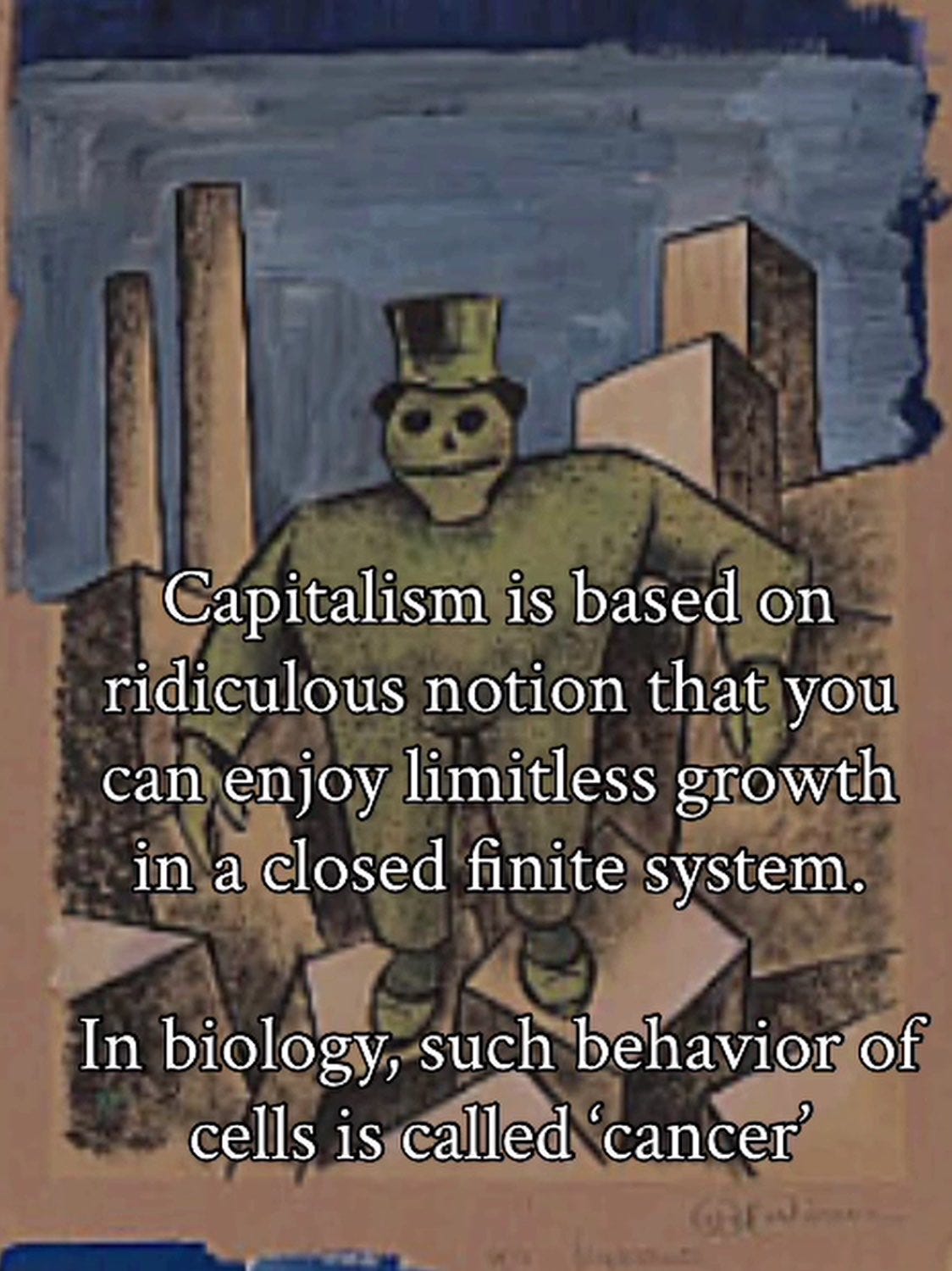
But this is not what economists mean by sustained growth. Growth, properly understood, is an increase in output per unit of input.
Technological efficiency is the mechanism. Simply extracting three times as much coal does not create sustained growth; at best it temporarily lowers coal prices. Growth comes from producing more value with fewer inputs. The historical transition from wood to coal to natural gas steadily reduced carbon intensity per unit of useful energy,[13] while solar and nuclear push that even further by generating energy without combustion altogether.
The Industrial Revolution was filthy not because growth is inherently filthy, but because it was picking the easiest, lowest-hanging fruit. We were burning the cheapest, dirtiest fuels available because better alternatives didn’t exist yet. However, its use paved the way to a civilization that eventually rendered coal increasingly obsolete. In that sense the growth was more than just sustainable, since it gave us the resources to make obsolete our older, dirtier, and less efficient technologies.
The alternatives exist because of growth. R&D requires capital, capital requires surplus, and surplus requires productivity. You don’t get geothermal or advanced nuclear without first accumulating the scientific and material base to develop them. The degrowth crowd wants to solve an environmental problem by eliminating the very engine that produces environmental solutions.
When Spinoza wanted to study optics, he ground his own lenses by hand because precision instruments were extraordinarily scarce. Today, schoolchildren buy microscopes and telescopes for less than the cost of a week's groceries. Every generation inherits a larger stock of knowledge and cheaper tools with which to expand it. Environmental innovation is no exception.
Growth has shown itself to be self-reinforcing and compounding upon itself. Today we produce more energy with less pollution than before.
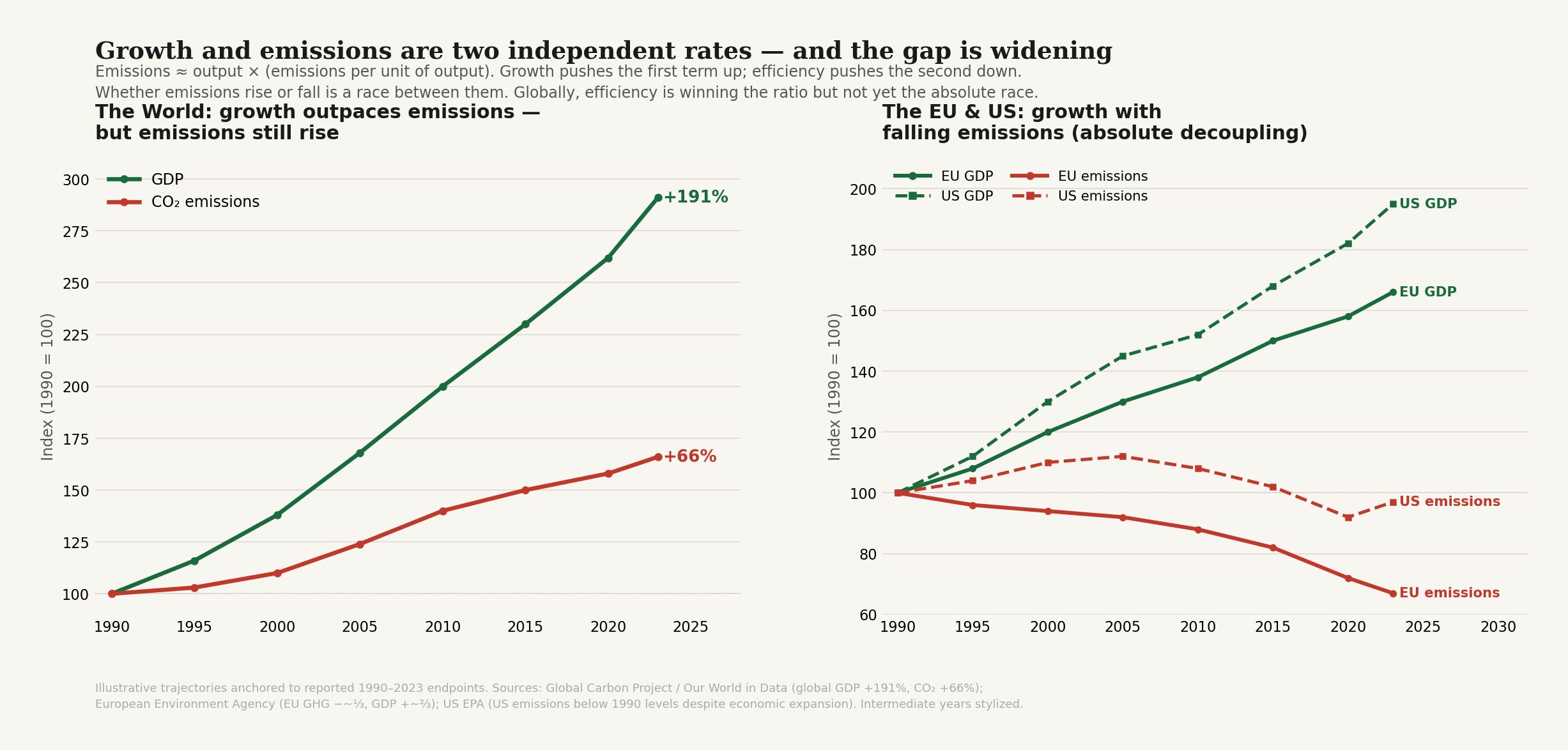
Had nineteenth-century Europe permanently abandoned industrial growth (a massive win for the degrowthers), we might never have accumulated the scientific and material resources needed to understand climate change, let alone mitigate it.
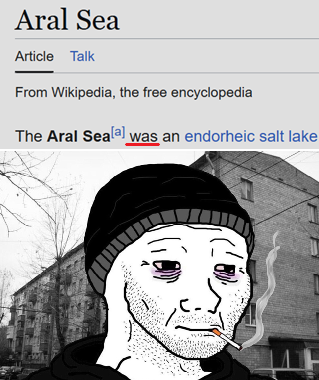
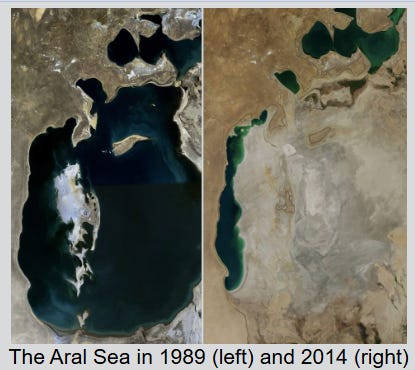
Some of the worst environmental catastrophes in recorded history happened in economies that explicitly rejected a capitalist growth framework. The Aral Sea.[14] Mayak/Kyshtym.[15] Chernobyl.[16] Command economies have some of the worst track records for pollution and environmental destruction on the planet. Economists even have theoretical reasons for modeling why: resource extraction driven by quotas rather than prices has no mechanism to signal when a resource is being depleted. A profit-seeking firm eventually stops extracting coal when it becomes too expensive. A private forestry company replants because future profits depend on future forests. A Soviet mining ministry extracting by quota doesn’t stop until the resource is gone, no matter how prohibitively expensive it becomes.
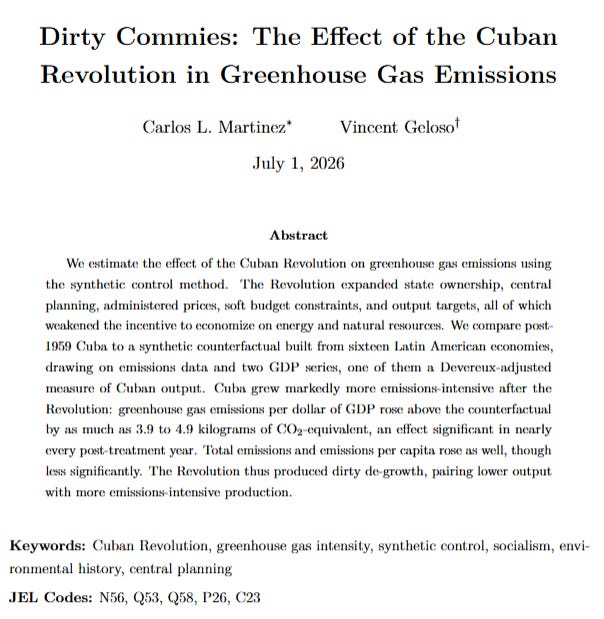
As I was finishing this essay, economist Vincent Geloso released new evidence on communist Cuba. The verdict is almost poetic: the revolution managed to produce both less wealth and more pollution per dollar produced.
My favourite example is that of the whales: by the late nineteenth century, whale blubber was already well on its way to becoming obsolete. As whale populations dwindled, prices soared. Hunting expeditions became longer, riskier, and increasingly unprofitable. The price mechanism did exactly what it was supposed to do: it nudged consumers and producers toward abundant substitutes.
The Soviet Union, however, operated largely through production quotas rather than prices. The result was that no matter how scarce they became, whale hunters still had a quota to hit, and the Soviet Union was almost single-handedly responsible for driving whales extinct.[17] Because prices offered no guidance, fishermen would go out for months and months hunting whales no matter how scarce they became in order to hit their quotas. Had planners not revised the quotas on the eve of being too late, whales might have joined the long list of extinct megafauna known only from museums.
If growth is the enemy, then the billions of people in South Asia and sub-Saharan Africa who want refrigerators, air conditioning, and abundant grocery stores are the enemy too. The only ethical path that gives developing nation the quantity of green energy Western nations aspire to, is more efficient production. Not less production.
The distribution problem
The distributional objection is subtler. Even granting that growth increases aggregate welfare, does it reach everyone? Or does it pool at the top while the bottom stays impoverished?
When Capital in the Twenty-First Century appeared, Thomas Piketty's famous r > g claim—that returns to capital outpace economic growth, causing inequality to compound indefinitely—was widely treated as a law of nature.[18] However, the model’s predictions depend on assumptions that haven’t always held, and[19] the empirics have been messier than the theory.
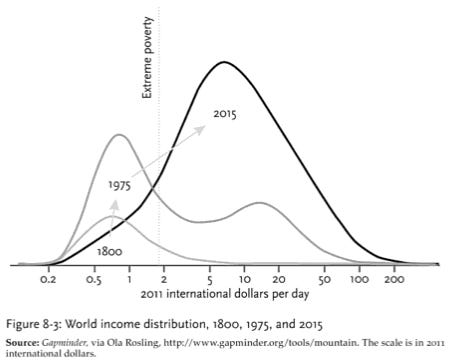
The global Gini coefficient has fallen, not risen.[20] Extreme poverty has more than halved since 1990.[21] Over a billion people escaped it not primarily through redistribution, but through sustained economic growth; most notably as China and India integrated into the world economy and produced goods the rest of the world wanted to buy.[21]
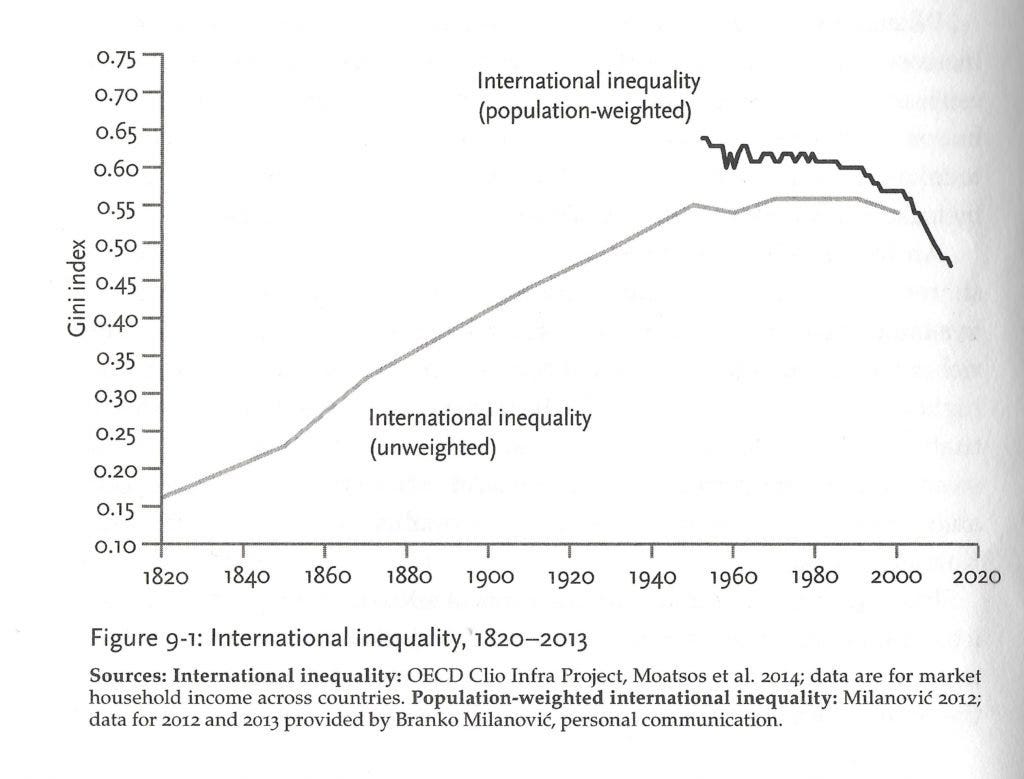
The empirical results have been a reduction of the bimodality of global income distribution, and actually a pooling of income in the hands of the middle class.[22] The world has not been splitting into rich and poor, but rather into a global middle that has steadily expanded. The feared polarization of world incomes has, at least so far, failed to materialize. I remain open to revising my opinion as the data changes.
The point of this essay isn’t to defend a particular growth mechanism (that’s the next one) it’s just to defend growth itself. Whatever you think about the role of the state and welfare, the empirical record is that the societies that grew fastest did more to reduce poverty than the societies that prioritized redistribution over production. You can’t legislate and redistribute your way out of poverty if there is not first a sum to be distributed.
Within countries, the picture is more complicated. The decline of manufacturing towns in the American Midwest, northern England, or parts of Canada imposed real costs on real people. Few growth advocates are willing to deny that there are never losers from competition in global markets. Inferior producers go bankrupt and their former customers come to enjoy access to cheaper or qualitatively superior goods from more competitive foreign producers. Denying that would be dishonest. But the alternative — protecting industries that are no longer productive, keeping people employed making things the world doesn’t want anymore — is hardly prudent or compassionate. It’s a slower version of the same decline, minus the possibility of something better on the other side.
As Paul Krugman often notes in introductory trade texts, the gains from trade are typically large enough that a small tax on the winners could fully compensate the losers while still leaving everyone better off.[23] Consumers get access to superior goods from across the entire planet, and the inferior producers who can no longer compete could be subsidized to retrain or move where new opportunities are being created. Free trade versus protectionism is not an all-or-nothing choice.
The moral problem
This is, for me today, the easiest objection to discard; but I have to remind myself that’s only because I spent years voraciously reading and writing about it. For many, many months, when I was first interested in economics, the biggest problem in the world switched from brain disease to single-mindedly pursuing whether profit was morally permissible. Were it not, I would have to pick a science and go all in on that, and save the economics for someone else.
My thoughts were this: If profit is immoral (exploitation) I have a moral imperative to do everything in my power to end it, even if it makes my life materially worse. It is not better to reign in hell than to serve in heaven. However, if profit was the result of mutually beneficial and voluntary exchange, I would be compelled by those same moral obligations to pursue and cultivate it wherever possible.
After much reading and reflection, I have ended up closer to the latter position, albeit with many caveats.
First and foremost, after reading Marx and his critics, it seems his critics are broadly correct. Relying on socially necessary surplus labour calculations to ascertain the ratio of exploitation of the workers is not a descriptively accurate way to understand profit and prices. The apparatus Marx has prepared for us is internally inconsistent, and fails to offer any explanatory power or useful predictions. It is a moral indictment that would be true if it accurately described price formation—which it does not.
I've argued elsewhere, at much greater length, why the labour theory of value collapses on its own terms. I won't relitigate it here, but you may read my thoughts below from my years spent reading Marx and the other classical communists.

Most people, of course, don’t spend years reading Marx and his critics. They rely on a vibes-based intuitive reaction: it feels wrong for a firm to close a factory in Indiana paying $12/hour and open one in Indonesia paying $0.50/hour.
First of all, I always remind myself that I am not more intelligent than any given Indonesian despite my fancy degrees. It is not my role to tell them how they should and should not live their own life, or if they are being exploited and are “tricked” into their own employment. I think that’s a crude and foolish “white man’s burden” you can accidentally woke your way into. But besides that general guiding sentiment, we always have to compare opportunity costs. Life doesn’t ask us what we want; it presents us with options.
A worker moving from subsistence rice farming—sometimes earning less than a dollar a day during harvest periods while working 16-hour days—to factory work earning several times that is not choosing between ideal and exploitative conditions.[24] They are choosing between available conditions.
If I could wave a wand and place everyone in high-paying, air-conditioned offices, I would. But that is not the relevant counterfactual. The relevant comparison is between the options that actually exist. A factory does not eliminate all prior choices, it merely adds one more, often better than the existing set.
Meanwhile, as industry is being brought to Indonesia, they will be able to garner higher tax revenues for their own social programs, and the populace will be able to save to build their own businesses. Nobel Prize winning trade economist Paul Krugman has documented how Indonesian per-capita calorie intake rose from ~2,100 to ~2,800/day and child malnutrition fell.[25] Sweatshop rhetoric usually parades the American worker who got laid off, while neglecting the third worlder who is making double or triple the money, working fewer hours, and no longer doing back-breaking farm work.
A similar story is true for people who say the global north exploits the global south with trade due to power imbalances. Power asymmetries are no doubt real and may make trade lopsided, but they do not negate the incredible gains to be made for both parties. Poor countries overwhelmingly prefer trading with rich ones over trading only with other poor ones, precisely because it expands their consumption possibilities. They export what they are relatively better at producing and import what they cannot efficiently produce at all: medicine, machinery, technology, and consumer goods. Poor nations being forced to trade only with other ‘poor’ & ‘global south’ nations would be a humanitarian disaster.
What’s perhaps more counterintuitive is that the richer nations benefit at all from trade with poorer nations. A rich nation like the US will still trade with a nation like Indonesia, even if the latter is worse at producing every single conceivable good. It is still beneficial for each to specialize and trade. This insight goes back to the birth of trade economics with Ricardo, and still to this day forms the basis of trade theory and trade practice.[26] Everyone benefits from trade: the rich and poor alike.
Comparative advantage is one of the earliest truisms economists were able to show with math instead of just fancy language and case studies:
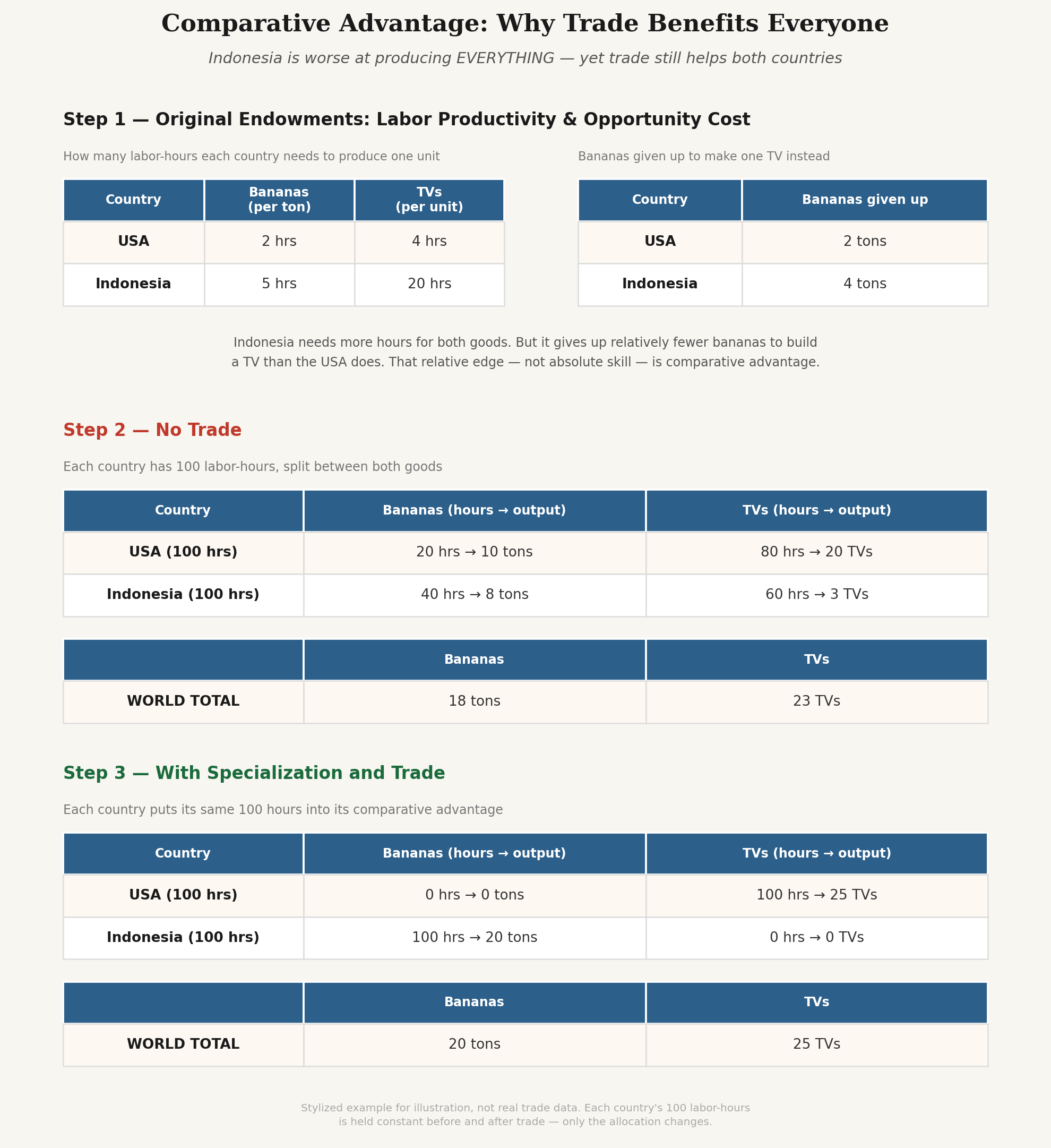
The math is clean and the conclusion is old news among economists.
Even if you think growth is morally suspicious, the best available interpretation of global labor and trade is still mutually beneficial exchange.
What growth practically means
People who oppose economic growth are usually people who already have what those seeking growth want. The people who need it most tend not to be represented at the conferences and in the journals where degrowth gets discussed. Degrowth is a privileged position for those inundated with creature comforts and long lives ahead of them.
Due to economic growth, the things we care most about are more accessible than ever. The supply of education, food, and healthcare have all risen enormously for the average person. While the rich of any given society were always able to access healthcare and education, for almost all of history, the masses were illiterate and died in childbirth or infancy. That today, poor losers like me can get an education, read papers online for free, and get access to cheap antibiotics gives me a standard of living higher than the pharaohs of Egypt and kings of Europe. I can even expect that my wife will not die during childbirth and we may be spared from the trauma and depression of several of our infant children starving to death in front of our eyes.
That’s what growth is, in the end. It’s the mechanism by which the accidents of birth matter less. Access to education and healthcare are among the greatest and most broadly distributed gifts of economic growth. My grandmother’s diabetes that killed her only a generation or two ago was the same disease that afflicts people today. The difference is that today we can treat it, for cheaper than ever.
Growth isn’t the enemy of the things we care about, it’s the necessary precondition for their existence. We face enormous problems, and future generations will face even larger ones. Crippling scientific research and technological growth by capitulating to reactionary degrowth is not a solution. It is a stigmata we inflict upon ourselves then pretend we have done something noble.
I am, by any reasonable historical standard, extraordinarily rich. Not because I’m exceptional or the inheritor of class privilege, but because I was born into an economy that had been growing, compounding, and accumulating productive capacity for centuries before I arrived.
I am the inheritor of growth.
Every scientist, artist, carpenter, nurse, teacher, engineer, and parent alive today is too.
If we want future generations to inherit even more than we did, on a greener earth with less pollution, the task is not to fear growth, but to continue it with more fervor than ever.

If you got value from this, pay whatever you think it was worth.
No subscription, no commitment.

Notes and References
Cowen, Tyler. 2007. Discover Your Inner Economist: Use Incentives to Fall in Love, Survive Your Next Meeting, and Motivate Your Dentist. New York: Dutton. (See Chapter 13)
Alzheimer’s Association. 2024. “2024 Alzheimer’s Disease Facts and Figures.” Alzheimer’s & Dementia 20 (5): 3708–3821. (Alzheimer’s prevalence ~5% at 65–74 rising to ~33% at 85+; “>30%” is the 85+ band.) I originally learned this in a lecture from Jim Davies.
My partner’s cousin really does this as a full-time research job. She started on squirrel linguistics and graduated to bat linguistics. Shout-out to Sarah.
Lucas, Robert E., Jr. 1988. “On the Mechanics of Economic Development.” Journal of Monetary Economics 22 (1): 3–42. Quotation at p. 5.
Mises, Ludwig von. 1951. Socialism: An Economic and Sociological Analysis. Translated by J. Kahane. New Haven: Yale University Press. See the section on marriage and the principle of contract (Chapter IV, “The Social Order and the Family”).
Mises, Ludwig von. 1956. The Anti-Capitalistic Mentality. Princeton, NJ: D. Van Nostrand. Quotation at p. 49. Incredible book all around. Highly recommend this short read.
Smithsonian Institution, Human Origins Program. “Homo habilis” and “Homo erectus.” Accessed July 2026. (https://humanorigins.si.edu) (Genus Homo dates to ~2.4–2.8 Mya; agriculture emerges ~12,000 years ago.)
Roser, Max. “Global GDP over the Long Run.” Our World in Data. Accessed July 2026. https://ourworldindata.org/grapher/global-gdp-over-the-long-run.
Accum, Frederick. 1820. A Treatise on Adulterations of Food, and Culinary Poisons. London: Longman, Hurst, Rees, Orme, and Brown. (Documents adulteration of bread with alum, chalk, plaster of Paris, and ground bones.)
Smil, Vaclav. 1998. “China’s Great Famine: 40 Years Later.” BMJ 319 (7225): 1619–1621. (Sparrow extermination in the Four Pests Campaign contributed to pest/locust surges and crop loss during the Great Leap Forward.) Also repeated in “Mao — The Unknown Story” by Jung Chang & Jon Halliday. (Albeit posited as an ipse dixit; common knowledge for children of those who lived under the regime at the time it was happening)
Robert, Vincent A., and Arturo Casadevall. 2009. “Vertebrate Endothermy Restricts Most Fungi as Potential Pathogens.” Journal of Infectious Diseases 200 (10): 1623–1626. (Each 1°C rise in the 30–40°C range excludes ~6% of fungal species; body heat is a key non-specific barrier.)
Casadevall, Arturo, Dimitrios P. Kontoyiannis, and Vincent Robert. 2019. “On the Emergence of Candida auris: Climate Change, Azoles, Swamps, and Birds.” mBio 10 (4): e01397-19. (Proposes that C. auris became a human pathogen via thermal adaptation to a warming climate.)
Ritchie, Hannah, and Max Roser. 2020. “Energy.” Our World in Data. https://ourworldindata.org/energy. (Long-run decline in carbon intensity per unit of useful energy across the fuel transition.)
Encyclopædia Britannica. “Aral Sea.” Accessed July 2026. https://www.britannica.com/place/Aral-Sea. (Soviet diversion of the Amu Darya and Syr Darya for cotton irrigation caused the desiccation.)
Trabalka, John R., L. D. Eyman, and S. I. Auerbach. 1980. “Analysis of the 1957–1958 Soviet Nuclear Accident.” Science 209 (4454): 345–353. (The Kyshtym/Mayak disaster: cooling-system failure in a buried liquid-waste tank; the Eastern Ural Radioactive Trace.)
United Nations Scientific Committee on the Effects of Atomic Radiation (UNSCEAR). 2011. Sources and Effects of Ionizing Radiation, UNSCEAR 2008 Report, Vol. II, Annex D: Health Effects Due to Radiation from the Chernobyl Accident. New York: United Nations. Wikipedia works just as well but I wanted to have a better citation than that.
Berzin, Alfred A. 2008. “The Truth About Soviet Whaling: A Memoir.” Marine Fisheries Review 70 (2): 4–59; and Clapham, Phillip J., and Yulia V. Ivashchenko. 2009. “A Whale of a Deception.” Marine Fisheries Review 71 (1): 44–52. (Plan-driven quotas led the USSR to kill ~180,000 whales unreported, 1948–1973, devastating stocks of several species.)
Piketty, Thomas. 2014. Capital in the Twenty-First Century. Translated by Arthur Goldhammer. Cambridge, MA: Belknap Press of Harvard University Press.
Rognlie, Matthew. 2015. “Deciphering the Fall and Rise in the Net Capital Share: Accumulation or Scarcity?” Brookings Papers on Economic Activity 2015 (1): 1–69; and Acemoglu, Daron, and James A. Robinson. 2015. “The Rise and Decline of General Laws of Capitalism.” Journal of Economic Perspectives 29 (1): 3–28. (Elasticity-of-substitution and depreciation critiques of r>g. See Notes: contested.)
Lakner, Christoph, and Branko Milanovic. 2016. “Global Income Distribution: From the Fall of the Berlin Wall to the Great Recession.” World Bank Economic Review 30 (2): 203–232. (Global interpersonal Gini fell from ~70 to ~62, 1988–2018. See Notes on scope.)
World Bank. 2018. Poverty and Shared Prosperity 2018: Piecing Together the Poverty Puzzle. Washington, DC: World Bank. (Extreme poverty fell from ~36% [1.85bn] in 1990 to ~10% [736m] in 2015 at $1.90/day; ~1.1bn fewer people in extreme poverty.)
Milanovic, Branko. 2016. Global Inequality: A New Approach for the Age of Globalization. Cambridge, MA: Harvard University Press. (Primary source for the declining bimodality / expanding global middle class — the data behind the graphs I ripped out of Pinker’s ‘Enlightenment Now’.)
Krugman, Paul R., Maurice Obstfeld, and Marc J. Melitz. 2018. International Economics: Theory and Policy. 11th ed. New York: Pearson. (Standard result: trade produces net gains such that winners could compensate losers and still leave everyone better off.)
Powell, Benjamin, and David Skarbek. 2006. "Sweatshops and Third World Living Standards: Are the Jobs Worth the Sweat?" Journal of Labor Research 27 (2): 263–274; and Harrison, Ann, and Jason Scorse. 2010. "Multinationals and Anti-sweatshop Activism." American Economic Review 100 (1): 247–273. (Sweatshop/apparel wages typically exceeded national average income)
Krugman, Paul. 1997. “In Praise of Cheap Labor: Bad Jobs at Bad Wages Are Better than No Jobs at All.” Slate, March 20, 1997.
Ricardo, David. 1817. On the Principles of Political Economy and Taxation. London: John Murray. (Comparative advantage; foundation of trade theory.)
National Gallery of Canada. 2026. “Helen McNicoll: An Impressionist Journey.” Exhibition, May 8 – October 12, 2026. Ottawa.
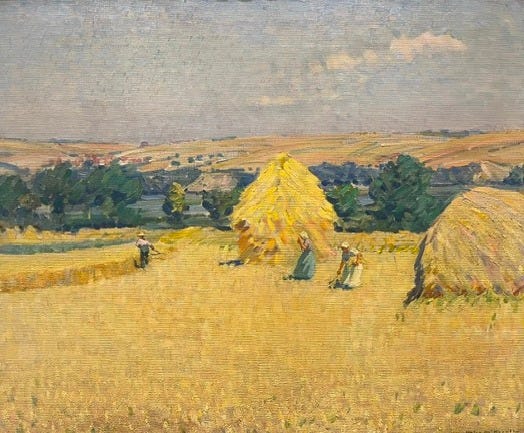
*Every painting used in this essay is by impressionist Helen McNicoll. Photos of her artwork were taken at her temporary exhibit at the National Gallery of Canada.[27] Art that I was able to see for free(!) on Thursdays from 5-8pm which, like everything else, is downstream of economic growth.
Whenever I hear someone talk about being born in the wrong generation, I remind myself how insanely well off we are in comparison to all of mankinds history.
What a great read, though, to me von Mises will always be an economist.